
Most IT decisions in SMBs feel safe, reasonable, and routine when they are made, because systems are working, employees can do their jobs, and nothing appears broken. Because of that, IT decisions tend to happen quietly as contracts get renewed, tools get added, issues get patched, and everyone moves on.
This is where the real problem starts.
When nothing is visibly wrong, decisions are made without pressure to step back and look at the bigger picture, so costs feel justified, risks feel manageable, and each choice makes sense on its own. Over time, those reasonable decisions stack up.
The consequences rarely appear all at once, instead showing up later as overlapping tools, growing inefficiencies, security gaps that were not obvious at the time, and systems that struggle to support change. By the time leadership feels the impact, the root cause is buried under months or years of disconnected decisions, and the path to fixing it is no longer simple.
The Question That Changes Everything
Before any IT decision is made, there is one question every SMB should be able to answer clearly.
What business outcome is this supposed to support?
Or, said another way: If we approve this, what business result should we expect?
This is the moment most organizations skip. Not because the question is hard, but because it is rarely asked. Technology decisions tend to be framed around cost, urgency, or operational need, and by the time they reach leadership, the focus is usually on getting something done, not on whether the decision fits into a larger plan.
When leadership connects every IT decision to a business outcome, the conversation changes. Spend becomes intentional. Risk becomes visible. And IT starts serving as a strategic lever instead of an operational cost center.
The Cost of Skipping the Question
When that question is not asked, the cost does not show up immediately.
IT spend still feels justified. Systems still work. Decisions still get approved. The business keeps moving, which reinforces the belief that the approach is fine.
The cost shows up later, and it usually shows up as a combination of the following:
- Overlapping tools – Multiple platforms solving the same problem because decisions were made at different times without coordination.
- Unused or underused software – Licenses are paid for, but adoption never fully happens because the tool was chosen without a clear use case.
- Security gaps – Systems implemented without consistent security standards, creating vulnerabilities that are hard to find and harder to fix.
- Limited scalability – Technology that works fine today but cannot support where the business is headed.
- Budget surprises – Renewals, upgrades, and emergency fixes that were not anticipated because no one was planning ahead.
None of these are caused by a single bad decision. They are the result of many reasonable ones that were never connected to a strategy.
What Strategic IT Planning Actually Looks Like
Strategic IT planning does not start with tools, vendors, or upgrades. It starts with the business.
Growth goals, hiring plans, expansion initiatives, operational priorities, and risk tolerance are defined first. IT decisions are then evaluated against those realities, not in isolation.
Instead of reacting to renewals or recommendations, leadership is able to ask whether a proposed tool, platform, or investment actually supports the direction the business is moving.
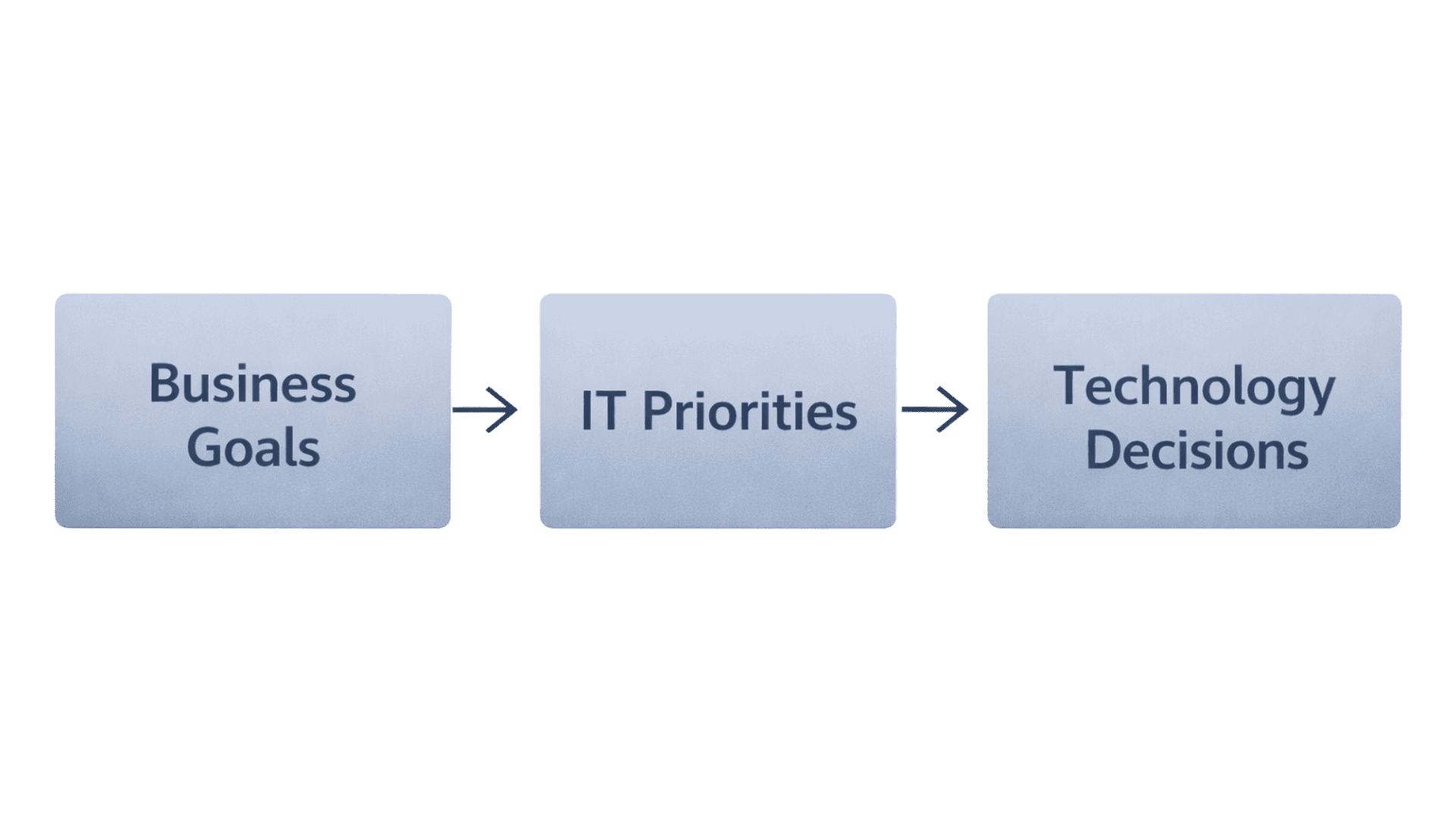
Strategic IT Planning Looks Like This:
Business Goals → IT Priorities → Technology Decisions
This approach is more thorough. It often takes more time. It requires stronger discipline.
But it replaces guesswork with intention.
When IT planning is done this way, decisions become easier to justify, easier to explain, and easier to defend. Spend becomes predictable. Risk becomes visible. Technology starts supporting the business instead of quietly pulling it off course.
This is the difference between managing IT and planning it.
What SMB Leaders Should Expect from a Strategic IT Partner
A strategic IT partner does not start with recommendations. They start by understanding the business, and then they do the harder work of turning that understanding into direction.
They take the time to learn how the business operates today and where leadership intends to take it. Growth plans, hiring goals, expansion, risk tolerance, and operational pain points are part of the conversation before technology is discussed.
From there, the partner builds a technology roadmap that aligns with those priorities, one that addresses what needs to change, what needs to stay, and what needs to be planned for. Decisions are connected to outcomes, and leadership has clear visibility into what is being spent, why, and what business result it supports.
The Bottom Line
Most SMBs do not overspend on IT because they are careless. They overspend because decisions are made without a consistent filter.
The question is simple and unavoidable.
What business outcome is this supposed to support?
If we approve this, what business result should we expect?
When this question leads every IT decision, technology stops drifting. Spend becomes intentional. Risk becomes visible. The business gains control instead of reacting to the next issue or invoice.
This is the difference between managing IT and directing it.
If you are planning growth, hiring, or operational changes this year, the next step is clarity. Review your current IT decisions against your business goals before spending another dollar.