
Your employees are already using AI. The question is whether you know about it.
Right now, someone on your team is pasting a client proposal, a financial summary, or a list of customer contacts into a free AI tool they found online, with no IT approval, no oversight, and no understanding of where that data goes next. According to a 2025 WalkMe survey, 78% of employees admit to using AI tools that were not approved by their employer. This is called shadow AI, and it is one of the fastest-growing, least-talked-about risks inside small businesses today. Most business owners have never heard the term. Many will assume it does not apply to them. That assumption is exactly what makes it dangerous.
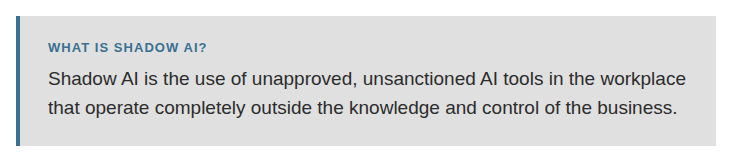
Most employees who use unauthorized AI tools have no idea they are doing anything wrong. They found something that works, it is free, and it makes their job easier. The problem is not the intention, but the exposure. Every time a team member pastes company information into an outside AI tool, that data leaves your business.
Understanding why it happens is important, but it does not change what it costs. Here is what small business owners need to know about the real risks of shadow AI.
Your Confidential Business Information Is No Longer Yours to Control
When an employee pastes a proposal, pricing model, or internal strategy into a free, unapproved AI tool, that content moves outside your business and into a third party platform you do not own, did not approve, and cannot monitor. Many of these platforms store user inputs to improve their models. By the time you realize it happened, there is no way to retrieve it.
With access, a cybercriminal can:
- Read existing conversations to understand relationships, timing, and tone
- Send messages from a trusted address to clients, vendors, or internal staff
- Distribute malicious attachments or links that appear legitimate
- Request payments, documents, or credentials under the guise of routine business
- Use the account to move laterally, targeting additional contacts without raising suspicion
Because the activity comes from a real account, it often blends into normal email traffic. The attacker’s advantage is not stealth, but credibility.
The longer an account remains compromised, the more trust can be leveraged and the harder it becomes to contain the downstream impact.
A Data Breach You Cannot Explain
Every time sensitive data moves through a free, unapproved AI tool, it leaves your control. These platforms are not bound by your security standards, your client agreements, or your industry regulations. If that data is exposed, you will be the one notifying clients, answering to regulators, and absorbing the cost. According to IBM, shadow AI contributed to 20% of data breaches in 2025 and added an average of $670,000 per incident.
Unauthorized AI Can Leave You Noncompliant and Legally Exposed
If your team handles client data, patient records, or payment information, unauthorized AI tools may already have put you in violation of HIPAA, PCI-DSS, or state privacy laws. These regulations do not require intent. They require compliance. The fines, investigations, and legal fees that follow a violation do not wait for an explanation. If your team handles client data, patient records, or payment information, unauthorized AI tools may already have put you in violation of HIPAA, PCI-DSS, or state privacy laws. These regulations do not require intent. They require compliance. The fines, investigations, and legal fees that follow a violation do not wait for an explanation.
Clients Do Not Give Second Chances
Client relationships are built on trust. When a breach or exposure becomes public, that trust breaks fast and rarely fully recovers. A single incident shared on social media, reported to a regulator, or mentioned in a review can define your business for years. You may never get the chance to explain what happened.
Bad Information Is Still Information
Unauthorized AI tools are not configured for your business, your industry, or your compliance requirements. When employees use them to analyze data, draft financial summaries, or inform business decisions, the output looks credible whether it is accurate or not. A bad decision made on flawed AI output carries the same consequences as any other bad decision. The tool is never the one held accountable.
Awareness is the first step. Once you understand where the risk lives, you can start closing the gaps. These five steps give you a practical place to begin.
1. Start With a Simple AI Policy
You do not need a legal team to get started. A one-page document that tells employees which tools are approved, what information can never be entered into an AI tool, and who to ask before trying something new is enough to close the most common gaps. The businesses most exposed to shadow AI are the ones with no policy at all.
2. Approve a Set of Business Grade AI Tools
Employees turn to free tools because they have nothing better available. When you provide vetted, approved AI tools that meet your security and compliance requirements, the incentive to go outside the system disappears. Give your team something they can use with confidence.
3. Train Your Team Once and Make It Stick
Most employees using unauthorized AI tools have no idea they are creating risk. A single focused conversation about what shadow AI is, why it matters, and what the rules are can change behavior immediately. You do not need a full training program. You need one clear message delivered consistently.
4. Know What Is Running on Your Network
If you do not have visibility into the tools your employees are accessing, you cannot manage the risk. Work with your IT provider to identify what AI tools are currently in use across your business. You may be surprised by what you find.
5. Treat AI Governance as an Ongoing Conversation
AI tools change fast. A policy you write today may need updating in six months. Build a habit of reviewing your approved tool list, checking in with your team, and staying current on what is available and what is risky. This is not a one time task. It is part of running a modern business.
Shadow AI is not a problem that resolves itself. The tools will keep evolving, employees will keep finding new ones, and the risks will keep growing. Staying protected means staying informed, taking the right precautions, and working with an IT partner who understands this landscape and knows how to navigate it on your behalf.